
The Master Manual to DataFlow Primary Source Verification (PSV) for GCC Regulators

DataFlow Primary Source Verification: The Complete GCC Licensing Guide
DataFlow Primary Source Verification (PSV) is the mandatory credential authentication process that every healthcare professional must complete before obtaining a license to practice in any Gulf Cooperation Council (GCC) country.
This comprehensive guide serves as DataFlow GCC licensing guide for doctors, nurses, pharmacists, and allied health professionals seeking regulatory approval in Saudi Arabia, the UAE, Qatar, Bahrain, Oman, and Kuwait.
The DataFlow Group, a third-party verification company headquartered in the UAE, is contracted by all six GCC health authorities to independently verify the authenticity of qualifications, experience, and professional registrations. The process works by contacting each institution that issued your documents—universities, hospitals, licensing boards—to confirm that your credentials are genuine, unaltered, and accurately represented.
Once verification is complete, DataFlow generates a report that is sent directly to the health authority you are applying to. Without a positive DataFlow report, no GCC health authority will process your license application.
Why DataFlow PSV Is Required Across All Six GCC Countries?
GCC health authorities introduced mandatory DataFlow PSV after discovering numerous cases of fraudulent credentials being used to obtain healthcare licenses. The verification system serves several critical purposes:
- Patient Safety – By verifying that every healthcare professional holds genuine qualifications, GCC authorities ensure that only properly trained individuals provide medical care. A single unqualified practitioner can endanger lives, and PSV is the frontline defense against this risk.
- Fraud Prevention – DataFlow has detected thousands of forged, altered, or misrepresented documents since its inception. Common fraud types include fabricated degree certificates, altered transcripts showing better grades, falsified experience letters inflating tenure or seniority, and certificates from unrecognized or non-existent institutions.
- Standardization Across the GCC– Rather than each authority developing its own verification process, the GCC adopted DataFlow as a standardized system. Every authority uses the same rigorous methodology, ensuring consistent verification quality regardless of which country you are applying to.
- Institutional Legitimacy – DataFlow does not just verify your documents—it also confirms that the issuing institutions are legitimate and recognized, protecting against “degree mill” qualifications that may look authentic on paper but come from unaccredited institutions.
- The requirement is non-negotiable: every single healthcare professional, regardless of nationality, experience level, or profession, must undergo DataFlow PSV. There are no exemptions, even for senior consultants with decades of experience.
DataFlow Verification Process: Step-by-Step
Every DataFlow verification case follows the same core stages: choose your authority, register and sign the Letter of Authorization, upload documents, and track your case until the report is issued. Here is the complete breakdown:
Step 1: Choose Your Authority and Case Package
The first step in the DataFlow verification process is selecting the specific licensing authority you are applying through—for example, DHA, DOH, MOHAP, SCFHS, QCHP, OMSB, NHRA, or Kuwait MOH. Each authority has its own case package with specific verification requirements and fee structures.
Step 2: Create an Account and Complete Registration
Register on the DataFlow portal (dataflowgroup.com) or through your licensing authority’s portal. You will need to provide personal details that match your passport exactly—any name discrepancies will cause delays or rejections.
Step 3: Upload Required Documents
Submit scanned copies of all required documents through the online portal. Documents must be clear color scans of originals, with names and dates matching exactly across all records.
Step 4: Sign the Letter of Authorization
The Letter of Authorization (LOA) is a mandatory document that allows DataFlow to communicate directly with your issuing institutions. A new signed copy of the LOA is required for each verification application.
Step 5: Pay the Verification Fee
Pay the required DataFlow fee payment through the portal. Fees vary by authority, profession, and the number of documents being verified. Budget approximately DH 800-2000 for standard verification.
Step 6: Track Your Application
Use your DataFlow case number or client reference number with your passport number to **track DataFlow status** on dataflowstatus.com. You can monitor progress in real-time and download your report once complete.
Step 7: Receive Your Verification Report
Once all institutions have responded and verification is complete, DataFlow issues a verification report with a QR code, which is forwarded directly to your licensing authority. A “Verified” status lets your application proceed; a “Discrepancy” flag requires resolution.
DataFlow Document Checklist: What You Need to Submit
Preparing the correct documents is the most critical step in the DataFlow verification process. Missing or incorrect documents are the number one cause of delays. Here is the comprehensive DataFlow document checklist:
Educational Documents
- Primary degree certificate – Your medical (MBBS/MD), nursing (BSN/Diploma), pharmacy (BPharm/PharmD), dental (BDS), or allied health degree certificate
- Academic transcripts – Complete transcripts for all years of study, showing subjects, grades, and dates
- Postgraduate qualifications – Specialty certificates, fellowship diplomas, master’s degrees, or any higher qualifications relevant to your profession
- Internship completion certificate – Required for medical graduates who completed a mandatory internship/housemanship year
- Board certification – If you hold board certification (e.g., American Board, Arab Board), include the certificate
Professional Documents
- Professional registration certificate – Current registration from your home country medical, nursing, or pharmacy council
- Good Standing Certificate – Issued by your previous licensing authority
- Employment/experience certificates – Official employer letters for all relevant positions, confirming role, start/end dates, and scope of practice
- Specialty training certificates – Post-graduate specialist qualifications relevant to your specialty classification
Identity Documents
- Passport copy – Bio-data page, valid for at least 6 months. Name must be consistent across all submitted documents
- Name change certificate – If your name on any document differs from the name on your passport
Additional Requirements
- Certified translations – Required for documents not issued in English or Arabic
- Letter of Authorization – Signed document permitting DataFlow to contact issuing institutions
DataFlow Verification Time: How Long Does It Take?
DataFlow verification time varies significantly based on several factors: the responsiveness of issuing institutions, the complexity of your credential history, and whether you have trained or worked in multiple countries.
Standard Processing Times
- Fast track (EU/UK graduates): 4–6 weeks1
- Standard (Asia, Africa, Americas): 6–10 weeks
- Slow cases (unresponsive institutions): 10–16 weeks
- Standard verification: 15–25 working days from payment and complete submission
- Express Service: Targets 14 working days (paid option)
Factors Affecting Timeline
- 1. Institutional responsiveness – Universities and licensing bodies that take time to respond to verification requests are the most common cause of delays
- 2. Document completeness – Missing or incorrect documents trigger requests for additional information
- 3. Multi-country verification – Each country’s institutions must be verified separately
- 4. Discrepancy resolution – Any mismatches between submitted information and verified data require resolution
Tips to Minimize Delays
- Start early – Begin the PSV process as soon as possible
- Double-check all documents – Ensure names, dates, and spellings are consistent across every document
- Respond quickly – Answer any verifier queries from DataFlow promptly
- Use professional assistance – Services like MediFlow can reduce average DataFlow time by 30–50% through proactive follow-up
DataFlow Fee Payment: Costs by Authority and Profession
DataFlow fee payment structures vary by authority, profession, and document count. Here is a breakdown of typical costs:
UAE Authorities
– DHA DataFlow: AED 1,500–2,500 (approximately USD 410–680)
– DOH DataFlow: AED 1,800–3,000
– MOHAP DataFlow: AED 1,200–2,000
– DHCC (Dubai): AED 1,150–AED 1,500 (USD 315–410)
Profession-Based Fees (DOH/HAAD)
– Consultants and Specialists: 1,680 AED
– General Dentists / General Practitioners: 1,260 AED
– Nursing & Midwifery / Pharmacy / Clinical Support: 990 AED
General Estimates
– Typical PSV cost: USD 150–300
– Budget range: USD 200–400 depending on document count
– Additional document fees may apply for extra credentials
– Report transfer fees: approximately 200 SAR for SCFHS transfers
### Payment Methods
Fees are paid through the DataFlow portal or your licensing authority’s portal during application submission. Keep all receipts and case IDs for your records.
—
DataFlow Status Tracking: Monitoring Your Application
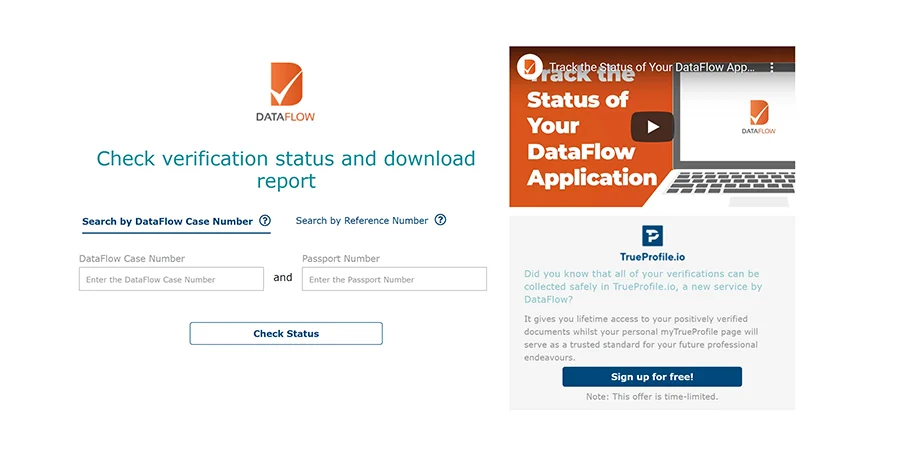
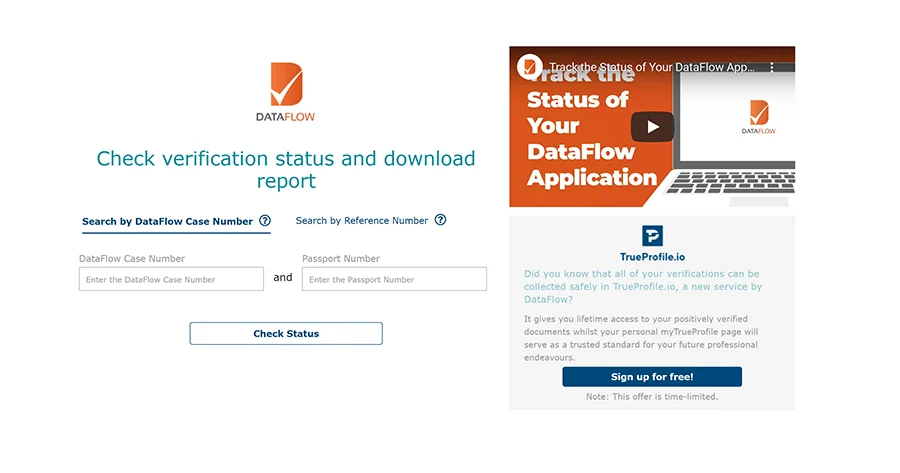
DataFlow status tracking is straightforward through DataFlow’s online tools. Here is how to monitor your application progress:
How to Check Your Status
- 1. Visit dataflowstatus.com
- 2. Enter your DataFlow case number (barcode) and passport number
- 3. The screen will display your case details and its progress
- 4. Revisit the same page to check status updates and confirm completion
What Statuses Mean
- – In Progress – Verification is ongoing
- – Verified– All documents have been successfully verified
- – Discrepancy – Mismatch found between submitted and verified data
- – Unable to Verify – The issuing institution could not confirm your credential
- – Insufficient Information – Additional documentation is required
What to Do If Issues Arise
- – Discrepancy or Unable to Verify – Qualifies for one free appeal within 180 calendar days (90 for UAE MOE cases)
- – Insufficient Information – Resolved through a paid Additional Document submission
- – Appeal process – File the appeal on dataflowstatus.com
DataFlow for SCFHS Saudi Arabia
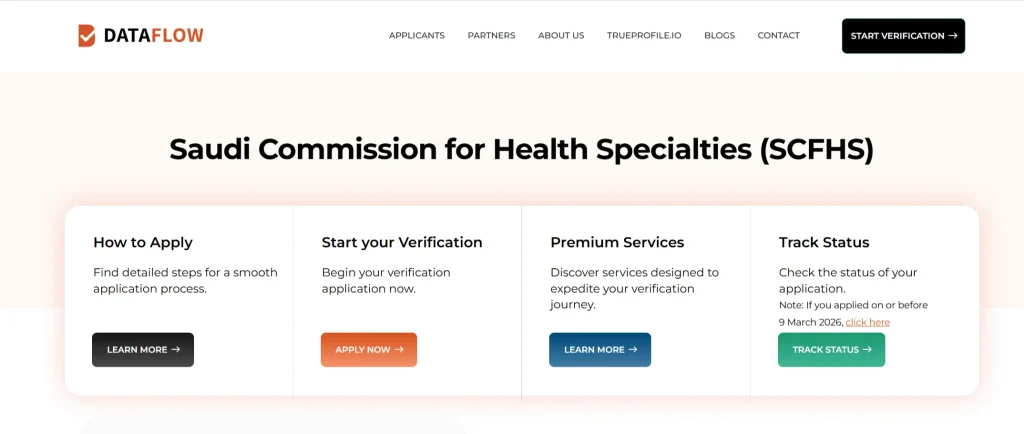
DataFlow for SCFHS Saudi Arabia is the mandatory PSV pathway for healthcare professionals seeking licensure in the Kingdom. The Saudi Commission for Health Specialties (SCFHS) has partnered with DataFlow Group as its official verification partner.
Key Requirements
- – Complete PSV through DataFlow is a mandatory requirement for admission to practice in the Saudi healthcare system
- – The SCFHS does not accept license applications without a valid DataFlow Report
- – Verification is initiated through the SCFHS Mumaris+ portal
Verification Process for Saudi Arabia
- 1. Create an applicant account on the DataFlow platform
- 2. Select SCFHS as the relevant authority
- 3. Upload required documents: valid passport, degrees, professional licenses, and work references covering three to five years
- 4. Upload the Letter of Authorization
- 5. Pay the verification fee
- 6. Track status online
- 7. Receive official DataFlow Report with QR code
Post-Verification Steps
Once DataFlow verification is complete, candidates are usually admitted to the Saudi Medical Licensing Exam (SMLE). License types include:
- – Temporary license – At least one year of professional experience after graduation
- – Permanent license – At least three years of professional experience and passing the SMLE
- – Specialists – Proof of specialized further training and several years of clinical experience
Report Transfer
If you already hold a “Positive” DataFlow report issued for another GCC regulator, you can apply for a “Report Transfer” to SCFHS. Report transfer typically takes approximately 5 days if no additional documents are needed.
Mumaris + Official Website https://sso.scfhs.org.sa/
DHA DataFlow Verification Dubai and MOHAP UAE Requirements
DHA DataFlow verification Dubai and MOHAP UAE DataFlow requirements form the backbone of UAE healthcare licensing. In the UAE, DataFlow is relied upon by major health authorities including the Dubai Health Authority (DHA), Department of Health Abu Dhabi (DOH), and Ministry of Health and Prevention (MOHAP).
UAE Authority Overview
- – DHA (Dubai) – For healthcare professionals intending to work in Dubai
- – DOH (Abu Dhabi) – For healthcare professionals intending to work in Abu Dhabi
- – MOHAP – For healthcare professionals intending to work in Sharjah and other northern emirates
Mandatory Requirement
DataFlow primary source verification is mandatory for every healthcare professional applying for a medical license in the UAE. Every doctor, nurse, pharmacist, or allied health professional must pass DataFlow verification before receiving a UAE medical license—no exceptions.
Documents Verified
- – Educational credentials (primary medical degree, postgraduate qualifications, academic transcripts, internship certificates)
- – Professional experience (employment letters from all previous employers, good standing certificates)
- – Specialty board certifications
Submission Process
DataFlow is initiated through your licensing authority portal (Sheryan for DHA, MOHAP portal, or DOH’s Malaffi system). You pay the DataFlow fee and submit documents online. DataFlow then contacts your university, hospital employer, and licensing bodies directly.
UAE DataFlow Costs (2026)
- – DHA DataFlow: AED 1,500–2,500
- – DOH DataFlow: AED 1,800–3,000
- – MOHAP DataFlow: AED 1,200–2,000
OMSB Oman DataFlow Process
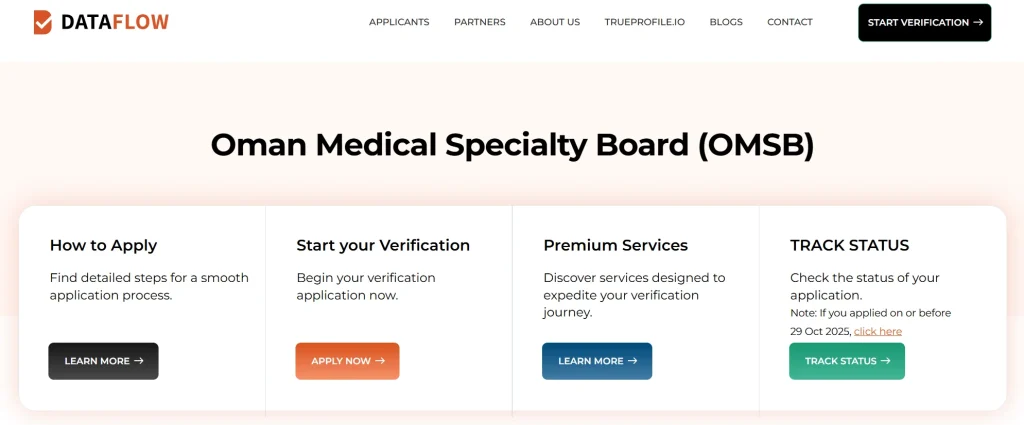
OMSB Oman DataFlow process is the mandatory verification pathway for healthcare professionals seeking licensure through the Oman Medical Specialty Board. All healthcare professionals who have qualified and gained experience outside of Oman must verify their credentials in order to obtain an OMSB equivalency.
Who Must Complete OMSB DataFlow?
- – Physicians
- – Nurses
- – Pharmacists
- – Allied healthcare staff
OMSB DataFlow Process
- 1. Visit the DataFlow Group website to initiate the verification process
- 2. Choose the Oman Medical Specialty Board (OMSB) option
- 3. Submit documents including educational certificates, experience certificates, professional licenses, passport copy, and CV
- 4. Pay verification fees
- 5. Track your application status
Key Features
- – OMSB has leveraged DataFlow’s PSV to ensure the competence and accuracy of applications
- – DataFlow makes it easier and faster to verify qualifications and experience
- – Helps professionals obtain work permits or health licenses more efficiently
- – Mandatory before taking the OMSB exam
Visit OMSB Websitehttps://www.omsb.gov.om/
Qatar QCHP DataFlow Verification
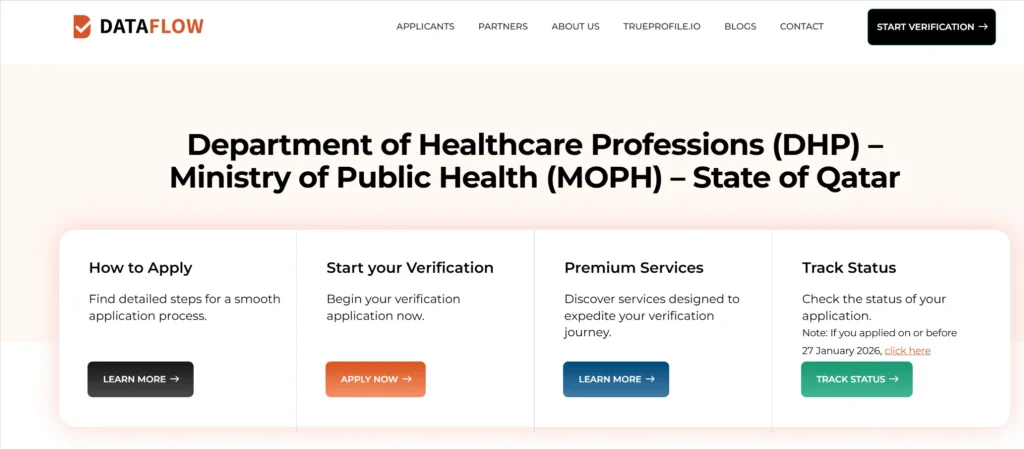
The Qatar Council for Healthcare Practitioners (QCHP) requires DataFlow Primary Source Verification for all healthcare professionals seeking licensure in Qatar.
QCHP DataFlow Requirements
- – Applicants must apply for Primary Source Verification on DataFlow
- – Download the DataFlow application form from the QCHP website
- – Upload MBBS, internship, license, and work experience documents
- – Pay verification fees and save all references and receipts
- – Track institution responses and answer verifier queries quickly
- – Use completed PSV status to move toward exam registration
Important Update
From January 2026, Dataflow Primary Source Verification (PSV) became mandatory for all QCHP applicants. Cross-check every date across your CV and experience letters to avoid discrepancies.
Visit QCHP Official Website here: https://dhp.moph.gov.qa/
Bahrain NHRA DataFlow Verification
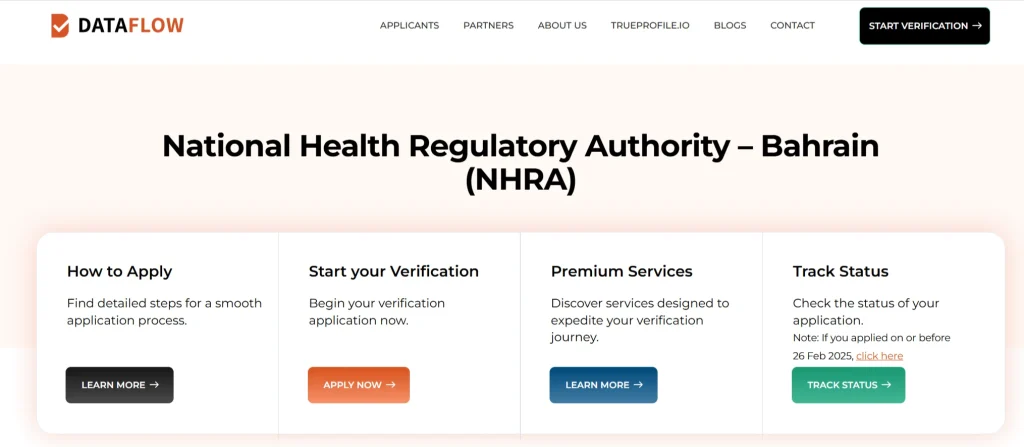
The National Health Regulatory Authority (NHRA) in Bahrain has partnered with DataFlow Group since 2017 for Primary Source Verification.
NHRA DataFlow Features
- – DataFlow is NHRA’s trusted partner for PSV to screen credentials of healthcare professionals applying for licenses to practice in Bahrain
- – DataFlow verifies Good Standing Certificates for NHRA at no extra cost
- – The verification package includes all mandatory verifications based on NHRA’s requirements
- – NHRA now accepts both DataFlow and Quadrabay for PSV
Requirements
- – NHRA requires DataFlow Primary Source Verification for all international healthcare professionals
- – Educational qualifications must be verified
- – Good Standing Certificate is mandatory
- Visit National Regulatory authority here: https://www.nhra.bh/
Kuwait MOH DataFlow Verification
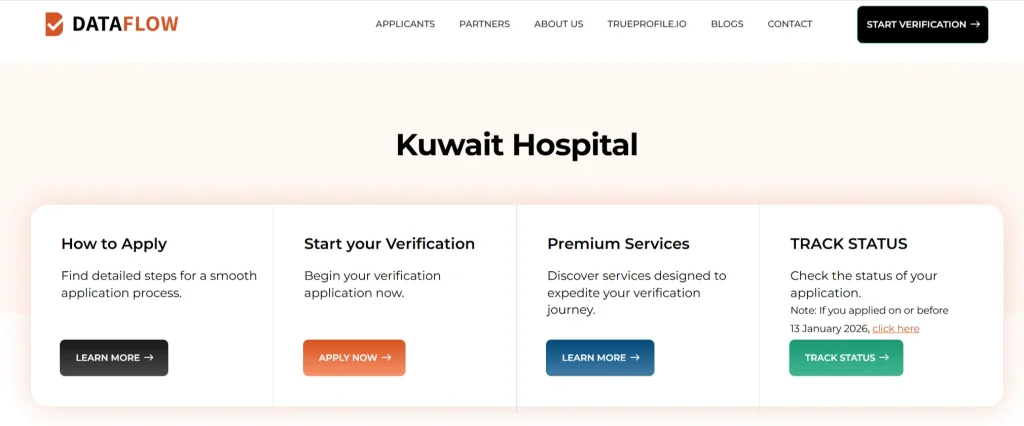
Kuwait’s Ministry of Health (MOH) has a document-intensive verification process. The **DataFlow verification process** for Kuwait MOH follows the standard DataFlow pathway.
Kuwait MOH Process
- 1. Confirm eligibility requirements first
- 2. Start PSV with the document set MOH Kuwait lists
- 3. Upload clean, color scans with names and dates matching your passport and CV
- 4. Pay verifier fees and keep every receipt and case ID for your MOH Kuwait application
Key Considerations
- – Kuwait’s MOH licensing process is known for being the most document-intensive in the GCC
- – The authority requires extensive documentation
- – Review process involves multiple stages
- – Most Kuwait candidates move through profile setup, primary source verification, exam clearance, and final registration Visit Ministry of health Kuwait here: https://www.moh.gov.kw/
DataFlow Verification for Pharmacists
DataFlow verification for pharmacists follows the same rigorous PSV process as other healthcare professionals, with specific document requirements tailored to pharmacy practice.
Pharmacy-Specific Requirements
- – Recognized pharmacy degree (B.Pharm or PharmD)
- – Pharmacy council registration verification
- – Experience letters from pharmacy practice positions
- – Good Standing Certificate from pharmacy licensing authority
Applicable Authorities
Pharmacists must complete DataFlow verification for licensing with:
- – SCFHS (Saudi Arabia)
- – DHA/DOH/MOHAP (UAE)
- – QCHP (Qatar)
- – OMSB (Oman)
- – NHRA (Bahrain)
- – Kuwait MOH
Common Documents for Pharmacists
- – Pharmacy degree (BPharm/PharmD) and transcripts
- – Professional registration evidence from home country
- – Certificate of Good Standing
- – Employment experience certificates
DataFlow Report Transfer Between GCC Regulators
The ability to transfer a verified DataFlow report between regulators represents a critical mechanism for professional mobility across the GCC.
What Is Report Transfer?
Report Transfer is a service provided by DataFlow where applicants can transfer their previously verified DataFlow Primary Source Verification Report from one regulator to another.
How to Transfer
1. Log in to the required regulator portal with your username and password
2. Submit a new signed copy of the Letter of Authorization
3. Select the new health regulatory authority to transfer the report to
4. Pay the transfer fee (approximately 200 SAR for SCFHS)
Transferability
- – Reports can be transferred between GCC health regulators
- – Valid for SCFHS (Saudi Arabia), DHA (Dubai), OMSB (Oman), and other GCC authorities
- – Transfer typically takes approximately 5 days if no additional documents are needed
- – Some jurisdictions may require additional Cross-Check verification with associated fees
Common DataFlow Issues and How to Resolve Them
1. Unresponsive Institutions
- Problem: Your university or previous employer doesn’t respond to DataFlow verification requests.
- Solution: DataFlow has alternative verification procedures for defunct employers, including government employment registries and professional association records. Professional services can escalate verification requests through established networks.
2. Document Discrepancies
- Problem: DataFlow flagged a discrepancy on your documents.
- Solution: Discrepancies are often minor (e.g., name spelling differences) and can be resolved with additional supporting documentation. File an appeal within 180 calendar days.
3. Name Inconsistencies
- Problem: Name on documents differs from passport.
- Solution: Submit a name change certificate. Ensure exact name consistency across all records before submission.
4. Incomplete Documentation
- Problem: Missing required documents.
- Solution: Review the complete DataFlow document checklist before submission. Ensure all documents are clear, valid, and up-to-date.
5. Translation Issues
- Problem: Documents not in English or Arabic.
- Solution: Obtain certified translations from approved translators.
Expert Tips for a Smooth DataFlow PSV Experience
- 1. Submit accurate information – Double-check all details before submitting
- 2. Stay organized – Keep digital copies of your documents for easy access
- 3. Begin early – The PSV process can take several weeks to months, so start as soon as possible
- 4. Follow up – Keep track of your application status and follow up with DataFlow if necessary
- 5. Use professional services – Companies specializing in healthcare licensing can assist with the verification and licensing process to avoid delays
- 6. Cross-check every date – Ensure dates across your CV, experience letters, and other documents are consistent
- 7. Maintain name consistency – Use the exact same name format across all documents as appears on your passport
Dtaflow Official Website : https://dataflowgroup.com/
Conclusion
DataFlow Primary Source Verification is the gateway to healthcare practice in all six GCC countries. Whether you are pursuing DataFlow for SCFHS Saudi Arabia, DHA DataFlow verification Dubai, MOHAP UAE DataFlow requirements, OMSB Oman DataFlow process, or licensure in Qatar, Bahrain, or Kuwait, understanding the complete verification process is essential for a successful application.
This DataFlow GCC licensing guide has covered the entire PSV journey: from the DataFlow verification process and comprehensive DataFlow document checklist to DataFlow status tracking, DataFlow verification time expectations, and DataFlow fee payment structures. By following the guidelines outlined here and preparing thoroughly, healthcare professionals can navigate the DataFlow verification process efficiently and avoid costly delays.
Remember: without a positive DataFlow report, no GCC health authority will process your license application. Start early, prepare meticulously, and leverage the resources available to ensure your credentials are verified accurately and promptly.