Table of Contents
Introduction
If you are an anesthesiologist planning to practice in the Gulf Cooperation Council (GCC) countries, understanding the GCC anesthesia license requirements is your first and most critical step.
Each Gulf nation operates its own regulatory authority with distinct eligibility criteria, examination systems, and exemption pathways.
Whether you are targeting Saudi Arabia’s lucrative tax-free salaries, Dubai’s world-class medical facilities, or Qatar’s growing healthcare sector, this comprehensive anchor post covers everything you need to know about obtaining your anesthesia license across all six GCC countries in 2026.
Anesthesiology is currently one of the most in-demand and best-paid medical specialties in the Gulf region. The anesthesiologist-to-operating-room ratio remains below international standards, and every new hospital tower adds operating rooms without enough anesthesiologists to cover their shifts.
This demand creates exceptional opportunities — but only for those who successfully navigate the licensing process.
This guide covers:
- Qualification and experience requirements for each country
- Exam syllabi and Prometric test structures
- Exemption criteria for internationally trained specialists
- Step-by-step application processes
- Timelines and estimated costs
- Key differences between regulatory authorities

Saudi Arabia – SCFHS Anesthesia License {#saudi-arabia}
The Saudi Commission for Health Specialties (SCFHS) is the regulatory authority responsible for licensing all healthcare professionals in Saudi Arabia. Without an active SCFHS license and a valid MUMARIS+ registration, you CANNOT practice anesthesiology in Saudi Arabia.
Qualification and Experience Requirements
For anesthesia specialists, SCFHS requires:
Educational Level: A qualification or clinical training program specialized for physicians, undertaken after a bachelor of medicine and surgery, that is not less than 24 months.
Educational Field: Medicine and Surgery.
Experience: For non-Saudis, experience must not be below one year, with the exception of graduates of Saudi universities.
SCFHS Licensing Steps
Step 1: Create Mumaris Plus Account
The official online portal used by SCFHS for all healthcare licensing applications. You will need:
Step 2: DataFlow Primary Source Verification (PSV)
DataFlow verifies your educational certificates, licenses, and experience documents from original sources. This is mandatory before Professional Classification and is one of the first GCC anesthesia license requirements.
Step 3: Apply for Professional Classification
Submit your qualifications, experience, and required documents for SCFHS professional classification review.
Step 4: Pass the Exam
Pass the SCFHS Prometric Exam to prove your professional competency. The Saudi Licensing Exam (SLE) for anesthesia covers:
- Airway management
- Preoperative assessment
- Anesthesia pharmacology
- Monitoring
- Regional anesthesia
- Obstetric anesthesia
- Pediatric anesthesia
- Critical care
- Pain management and emergencies
Step 5: Receive Professional Classification
After successful verification and exam completion, SCFHS issues your Professional Classification Certificate.
Step 6: Obtain Job Offer
Apply for healthcare jobs in Saudi Arabia after receiving your SCFHS classification approval.
Step 7: Professional Registration
Complete SCFHS professional registration after joining your employer to activate your Saudi license.
Salary Expectations for Anesthesiologists in Saudi Arabia
- General anesthesiologist, 3–5 years: SAR 28,000–38,000/month (USD 7,450–10,100)
- General anesthesiologist, 6–10 years: SAR 35,000–48,000/month (USD 9,300–12,800)
- Subspecialist (cardiac, pediatric, obstetric, chronic pain): SAR 45,000–70,000/month (USD 12,000–18,650)
- Consultant anesthesiologist: SAR 60,000–95,000/month (USD 16,000–25,300)
Note: There is no personal income tax on salary in Saudi Arabia — gross is essentially net.
Read Our Step Wise Guide for SCFHS Exam
Click Here

United Arab Emirates – DHA, DOH & MOHAP {#uae}
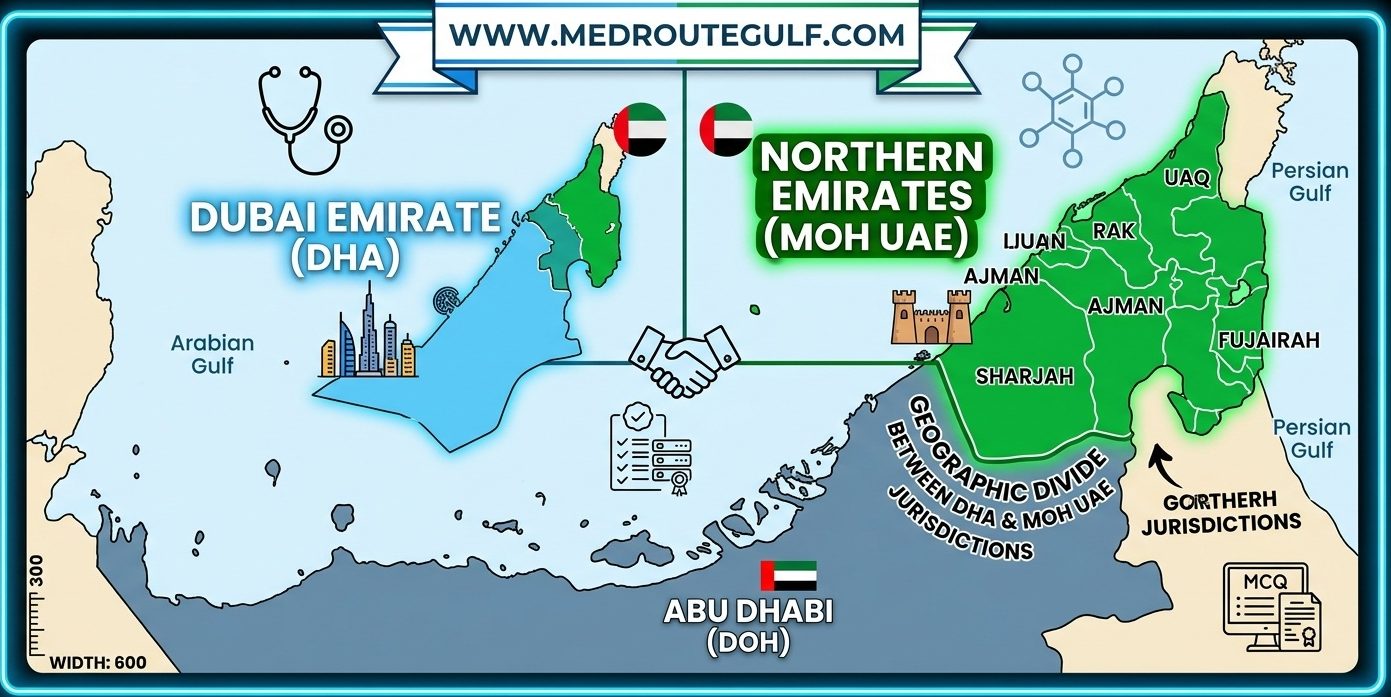
The next section in GCC anesthesia license requirements focuses on UAE. UAE operates three separate licensing authorities, each covering different emirates. Understanding which authority applies to your target location is essential.
Dubai – DHA (Dubai Health Authority)
DHA licenses healthcare professionals practicing in Dubai.
Eligibility Criteria:
- Recognized medical degree
- Minimum 2 years clinical experience
- Valid license in home country
- Good Standing Certificate
DHA Exam Pattern:
- Computer-based test
- 100-150 MCQs
- No negative marking
- Passing score: 60-70%
DHA Anesthesia Exam Coverage:
The anesthesia exam syllabus covers:
- Airway management
- Thoracic, cardiac & vascular anesthesia
- Organ-based anesthesia
- Trauma, burns & orthopedic surgery
- Regional anesthesia, acute & chronic pain
DHA Licensing Steps:
- Check Eligibility
- Apply for DataFlow
- Register for Exam
- Pass Exam (Prometric-style format)
- Apply for License
- License Issuance
Read Our Complete Guide about DHA Exams
Click Here
Abu Dhabi – DOH (Department of Health)
This section of GCC anesthesia license requirements focuses on Abu Dhabi. Formerly known as HAAD, DOH covers Abu Dhabi emirate including Al Ain and Al Dhafra.
DOH PQR System:
DOH uses the Professional Qualification Requirements (PQR) system — a unique, structured framework defining minimum qualification requirements for each healthcare profession.
DOH Requirements:
- Recognized medical degree from a DOH-recognized institution
- 2+ years experience for most professions; specialist physicians often need 3–5 years of specialty-specific experience
- DataFlow Primary Source Verification (mandatory, 4–12 weeks)
- DOH Prometric Exam (MCQ-based, specialty-specific, stricter than DHA)
- Attested documents (full attestation chain required)
- Good Standing Certificate (issued within 3–6 months)
Key Differences from DHA:
- DOH generally has stricter experience requirements
- More rigorous evaluation process for specialists
- Higher difficulty level for exams
Northern Emirates – MOHAP
This section of GCC anesthesia license requirements focuses on Northern Emirates. MOHAP (Ministry of Health and Prevention) covers the Northern Emirates (Sharjah, Ajman, Umm Al Quwain, Ras Al Khaimah, and Fujairah). The requirements are generally similar to DHA but with a distinct application pathway through the MOHAP portal.
Read Our
Step By Step Dataflow Process
Qatar – QCHP/DHP Anesthesia License {#qatar}
The Qatar Council for Healthcare Practitioners (QCHP) was restructured under Qatar’s Ministry of Public Health and is now officially the Department of Healthcare Professions (DHP). Both names refer to the same licensing authority.
Critical 2026 Update
This section of GCC anesthesia license requirements focuses on Qatar.
Starting January 1, 2026, DataFlow Primary Source Verification became mandatory for every single applicant, with no exceptions, under DHP Circular 2025/24.
Previously, some applicants with recognized international qualifying exams (NCLEX, USMLE, PLAB) could sometimes proceed without a full DataFlow report — that is no longer the case.
QCHP Licensing Requirements
Minimum Experience: Generally, the minimum experience required is three years.
Required Documents:
- Recent passport-sized photograph
- Copy of valid passport
- Practice license or registration from home/working country
Exam Details:
- Prometric CBT
- 150 MCQs
- 3 hours duration
- Covers all 16 categories
- Passing score: 60% (90/150)
- 5 consecutive sitting attempts allowed, any gap between attempts
QCHP Licensing Pathway
- Create account on DHP portal (qchp.org.qa)
- Submit documents for initial review
- Complete DataFlow Primary Source Verification
- Book and pass Prometric qualifying exam (SCHQ2)
- Post-exam license issuance
Timeline: 3–4 months from eligibility through license activation
License Validity: Typically 2 years for most categories
Important Note: International qualifications — including USMLE, PLAB, AMC, or other board certifications — do NOT exempt you from the Qatar pathway. They may support your eligibility assessment, but you must still complete DHP requirements including PSV and the Prometric qualifying exam.
Oman – OMSB Anesthesia License {#oman}
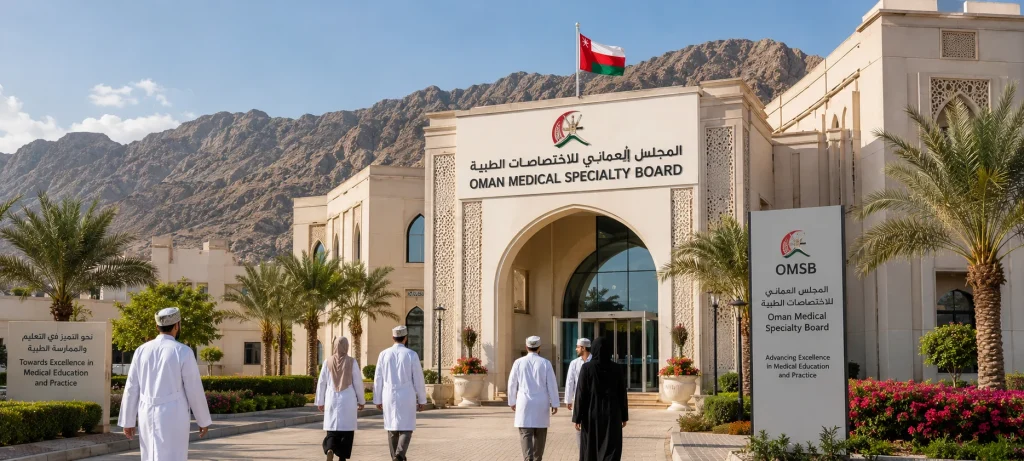
This section of GCC anesthesia license requirements focuses on Oman. Oman offers one of the most accessible GCC licensing pathways. The Oman Medical Specialty Board (OMSB) oversees licensing and regulation of all healthcare professionals in Oman.
Understanding OMSB vs MOH
It is important to understand that OMSB does NOT issue licenses — MOH does. The process works as follows:
- OMSB evaluates your specialty credentials and issues a classification certificate
- MOH then uses that certificate as the basis for issuing your practice license
OMSB Classification Levels for Anesthesiologists
OMSB classifies specialist-grade professionals into three tiers:
OMSB Requirements
Recognized Medical Qualification: Your degree must be from an OMSB-recognized institution.
Post-Qualification Clinical Experience:
- General practitioners: Minimum 2 years
- Specialists: Completed specialty training from an OMSB-recognized program plus post-training experience
- Consultants: Specialty training plus significant post-training experience (typically 5+ years)
OMSB Prometric Exam: Most professions must pass the OMSB specialty-specific Prometric exam before license issuance.
OMSB Anesthesia Exam Blueprint: The examination focuses on:
- Applied anatomy
- Physiology
- Clinical biochemistry
- Physics
- Clinical measurement
- Pharmacology
- Basic principles of anesthesiology
- General anesthesia
- Medical disorders related to anesthesia
- Critical care management
- Airway management
- Cardiac and vascular anesthesia
- Obstetric anesthesia
Required Documents:
- Primary medical degree certificate
- Postgraduate qualification certificates (fellowship, board certification, or equivalent)
- Transcripts
- Full CV in OMSB format
- Good Standing Certificate
- Attested documents
Timeline: 3–5 months end-to-end
License Validity: 2 years, renewable with CPD requirements
Key Advantage: Oman is widely regarded as having one of the most accessible GCC licensing processes, making it an attractive destination for professionals entering the GCC for the first time. The process is less complex than UAE’s three-authority system and Saudi Arabia’s rigorous SCFHS requirements.

Bahrain – NHRA Anesthesia License {#bahrain}
This section of GCC anesthesia license requirements focuses on NHRA Bahrain. The National Health Regulatory Authority (NHRA) governs all healthcare licensing in Bahrain. Bahrain offers one of the GCC’s most streamlined licensing processes.
Registration Categories
NHRA classifies healthcare professionals into three broad tiers:
NHRA Requirements
Recognized Medical Qualification: Your degree must be from an NHRA-recognized institution. Bahrain’s recognition list is broad, covering most internationally accredited universities.
Experience: Minimum 2 years post-qualification clinical experience for most professions.
NHRA Prometric Exam: Most healthcare professions must pass the NHRA specialty-specific Prometric exam before license issuance.
Exam Exemptions
Professionals with 5+ years of continuous clinical experience in a recognized healthcare facility may qualify for exam exemption, making Bahrain particularly attractive for senior practitioners.
Required Documents
- Valid passport copy
- Degree certificate(s) and academic transcript
- Valid professional license/registration from home country
- Official employer experience letters confirming role, dates, and scope of practice
- Certificate of Good Standing (valid 3–6 months from issue)
NHRA Key Facts for 2026
Strategic Advantage: Bahrain is connected to Saudi Arabia via the King Fahd Causeway, making it an excellent base for professionals who want access to both markets. Holding both NHRA and SCFHS licenses is a common strategy among GCC-mobile professionals.

Kuwait – MOH Anesthesia License {#kuwait}
This section of GCC anesthesia license requirements focuses on Kuwait. Kuwait’s Ministry of Health (MOH) regulates healthcare professionals practicing in Kuwait.
Kuwait MOH Requirements
Recognized Medical Qualification: Your degree must be from a recognized institution.
Experience: Kuwait typically requires 3-5 years of experience — higher than some other GCC countries.
Kuwait MOH Prometric Exam: Kuwait MOH requires Prometric examinations for most healthcare professions. The exam is specialty-specific and can be sat at Prometric centers internationally — you don’t need to be in Kuwait to sit the exam.
Kuwait MOH Licensing Steps
- Check Eligibility
- Apply for DataFlow / Credential Verification
- Register for Exam
- Pass Exam
- Apply for License
- License Issuance
Important Note on Allied Health Requirements
Kuwait has increased allied health requirements for 2025-2026. Physiotherapists, radiographers, and medical laboratory technologists now require 4 years post-qualification experience (previously 3).
Potential Additional Requirements
Some categories may require an in-person interview or clinical assessment at MOH Kuwait in addition to the written exam.
License Validity
Typically 2 years, renewable with CPD requirements.
GCC Anesthesia License Exemption Criteria Comparison {#exemptions}
One of the most frequently asked questions about GCC anesthesia license requirements is whether internationally trained anesthesiologists can be exempted from the licensing exam. The answer varies by country and qualification.
Exam Exemption Criteria by Country
| Qualification | DHA (Dubai) | DOH (Abu Dhabi) | SCFHS (Saudi) | QCHP (Qatar) | NHRA (Bahrain) |
|---|---|---|---|---|---|
| US Board (ABMS) | Exempt | Exempt | Likely exempt | Exempt | Exempt |
| UK CCT | Exempt | Exempt | Likely exempt | Exempt | Exempt |
| Australian/NZ Fellowship | Exempt | Exempt | Likely exempt | Exempt | Exempt |
| Canadian Royal College | Exempt | Exempt | Likely exempt | Exempt | Exempt |
SCFHS Exemption Details
Rather than offering a simple exam waiver, SCFHS uses a Tier 1 classification system. Group 1 professionals may be exempt from the Saudi Licensing Exam (SLE), but the exemption is not automatic — it is granted by the SCFHS Classification Committee during their credential review.
Critical SCFHS Exemption Details:
- Both qualification AND training must be from Group 1 countries (United States, Canada, United Kingdom, Australia)
- A physician who earned their MBBS in India but completed specialty training in the UK may or may not qualify
- The Classification Committee makes the final determination
Bahrain Exemption Details
Professionals with 5+ years of continuous clinical experience in a recognized healthcare facility may qualify for exam exemption.
Qatar Exemption Details
Qatari practitioners may be exempt. Physicians with a postgraduate degree with a minimum study duration of 1 year that includes accredited practical hours and clinical training may also qualify. International qualifications do not automatically exempt you — each case is evaluated individually.
No Automatic Exemptions
Important: Even if you qualify for exam exemption, you must still complete:
- DataFlow Primary Source Verification (mandatory in all GCC countries)
- Document attestation
- Professional classification review
- Good Standing Certificate submission
- QCHP Qatar GP Licensing: Dataflow to QCHP Exams For GP Complete Process
- GCC Anesthesia License Requirements: The Ultimate 2026 Guide for Every Gulf Country
- MOH UAE vs DHA: Which GP Exam Should You Choose in 2026?
- SMLE DHA Comparison 2026: Don’t Make This Costly Career Mistake
- OMSB Exam Preparation: Your Complete Roadmap to Oman GP Success
Securing your GCC anesthesia license requirements demands conquering two formidable hurdles: the stringent DataFlow Primary Source Verification (PSV) and the high-stakes Prometric specialty exams.
From Saudi Arabia’s SCFHS Tier 1 classification nuances to Qatar’s mandatory 2026 PSV regulations and the UAE’s DHA/DOH 150-MCQ formats, even a minor document mismatch or gap in exam preparation can derail your career by months.
A rejected verification or a failed attempt without a targeted strategy doesn’t just cost you time—it can cost you life-changing job offers. That’s where we simplify the complex.
Whether you need specialized coaching tailored to each country’s anesthesia blueprint, expert guidance to fast-track your DataFlow attestation, or full-service support from document legalization to license activation, our platform is your ultimate partner.
Stop navigating the bureaucratic maze alone. Take control of your future and visit MedRouteGulf today to access premium resources, personalized consultancy, and proven strategies that transform your GCC licensing journey from a stressful ordeal into a confident career leap.
Final Thoughts {#final-thoughts}
Navigating the GCC anesthesia license requirements across six different countries can be complex, but the opportunities for anesthesiologists in the Gulf region have never been greater. Each country offers unique advantages:
- Saudi Arabia offers the highest salaries and largest market, but has the most rigorous SCFHS requirements
- UAE provides multiple pathways through DHA, DOH, and MOHAP — choose based on your target emirate
- Qatar has a streamlined process through DHP but mandates DataFlow PSV for all applicants from 2026
- Oman offers the most accessible GCC licensing pathway
- Bahrain provides the most streamlined process with exam exemptions for experienced professionals
- Kuwait offers competitive opportunities but has higher experience requirements
Key Takeaways
- Start with DataFlow PSV — this is mandatory across all GCC countries and takes 4-12 weeks and is one of the first GCC anesthesia license requirements.
- Check your exemption eligibility — US Board, UK CCT, and other Western qualifications may exempt you from exams in most countries
- Plan ahead — the full licensing process typically takes 3-8 months depending on the country
- Secure a job offer — in most countries, final license activation requires employer sponsorship
- Maintain your Good Standing Certificate — ensure it is valid (typically 3-6 months) when you submit your application
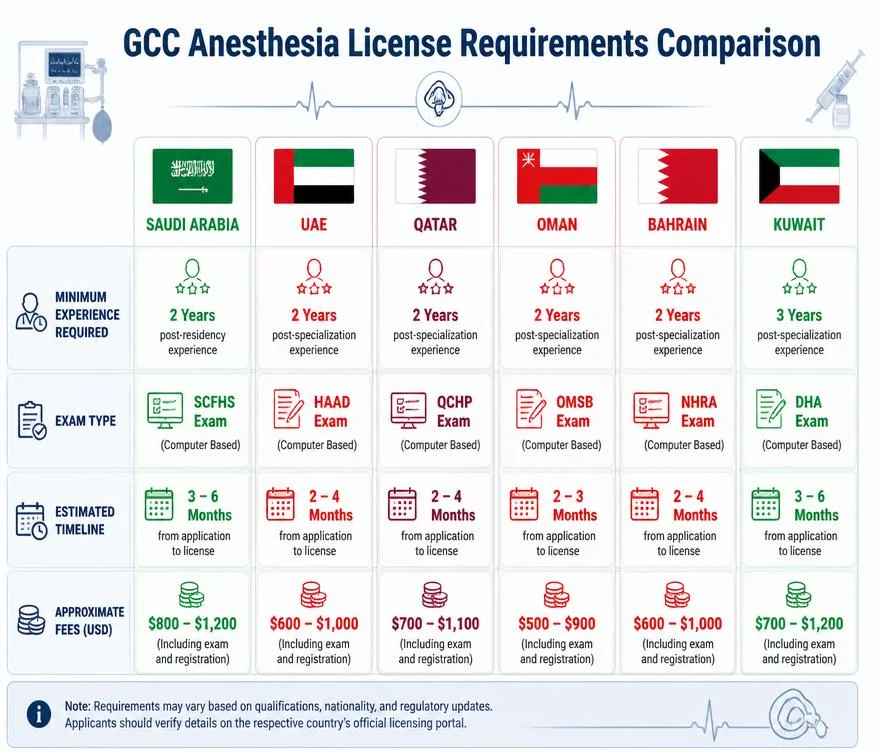
Quick Reference: GCC Anesthesia License Requirements at a Glance
| Country | Authority | Min Experience | Exam | Timeline | Exemption Available |
|---|---|---|---|---|---|
| Saudi Arabia | SCFHS | 1 year (non-Saudis) | Prometric SLE | 3-6 months | Tier 1 qualifications (case-by-case) |
| UAE (Dubai) | DHA | 2 years | Prometric (150 MCQs) | 4-6 months | US Board, UK CCT, etc. |
| UAE (Abu Dhabi) | DOH | 3-5 years (specialists) | Prometric (stricter) | 5-8 months | US Board, UK CCT, etc. |
| Qatar | QCHP/DHP | 3 years | Prometric (150 MCQs, 60% pass) | 3-4 months | Case-by-case |
| Oman | OMSB | 2+ years (specialists) | Prometric | 3-5 months | Varies by qualification |
| Bahrain | NHRA | 2 years | Prometric | 4-12 weeks | 5+ years experience |
| Kuwait | MOH | 3-5 years | Prometric | 3-6 months | Case-by-case |
Whether you are a newly qualified anesthesiologist or a senior consultant with decades of experience, the GCC offers exceptional career opportunities. By understanding the GCC anesthesia license requirements outlined in this guide, you can navigate the licensing process with confidence and take the next step in your international career.
Disclaimer: Licensing requirements are subject to change. Always verify current requirements on official authority websites before beginning your application.
What are the basic GCC anesthesia license requirements for an internationally trained doctor?
The foundational GCC anesthesia license requirements across all six countries include: a recognized medical degree in medicine and surgery, completion of a specialized anesthesia training program (minimum 24 months), post-qualification clinical experience (ranging from 1 to 5 years depending on the country), successful passage of the country-specific Prometric exam (unless exempted), and mandatory DataFlow Primary Source Verification (PSV) of all educational and professional documents. Additionally, you must submit a valid Certificate of Good Standing from your home country’s regulatory body and complete full document attestation through your home country’s embassy and the target GCC country’s embassy.
Is DataFlow Primary Source Verification (PSV) mandatory for all GCC countries?
Yes, DataFlow PSV is now a non-negotiable component of the GCC anesthesia license requirements for every single Gulf nation.
Which anesthesiologists are exempt from the Prometric exam in the GCC?
Exemption from the Prometric exam is one of the most sought-after aspects of the GCC anesthesia license requirements, but it varies significantly by country. In the UAE (DHA and DOH), anesthesiologists holding US Board certification (ABMS), UK CCT, Australian/NZ Fellowships, or Canadian Royal College certifications are generally exempt. In Saudi Arabia, SCFHS does not offer automatic exemptions—instead, they use a Tier 1 classification system where candidates with both their primary qualification AND specialty training from the US, UK, Canada, or Australia may be exempted, but the final decision rests with the Classification Committee. Bahrain offers exam exemptions for professionals with 5+ years of continuous clinical experience. Qatar and Kuwait evaluate exemptions on a case-by-case basis with no automatic waivers.
What is the difference between DHA, DOH, and MOHAP for anesthesia licensing in the UAE?
The UAE operates three separate regulatory bodies, making the GCC anesthesia license requirements uniquely complex within this single country. DHA (Dubai Health Authority) covers Dubai and requires 2+ years of experience with a 100-150 MCQ Prometric exam (passing score 60-70%). DOH (Department of Health) covers Abu Dhabi, Al Ain, and Al Dhafra; it requires 3-5 years of specialty-specific experience, uses the stricter PQR (Professional Qualification Requirements) system, and has a more rigorous exam format. MOHAP (Ministry of Health and Prevention) covers the Northern Emirates (Sharjah, Ajman, UAQ, RAK, Fujairah) with requirements generally similar to DHA but processed through a distinct application portal. You must apply to the specific authority based on your target emirate—they do not automatically transfer across emirates.
How many attempts are allowed for the Qatar QCHP anesthesia Prometric exam?
Under Qatar’s GCC anesthesia license requirements administered by the Department of Healthcare Professions (DHP), candidates are permitted 5 consecutive sitting attempts to pass the Prometric qualifying exam (SCHQ2). There is no mandatory gap period required between attempts, meaning you can rebook your next attempt as soon as the next available test date opens. However, each attempt carries a financial cost, and repeated failures may trigger additional scrutiny from the DHP classification committee. The passing score is 60% (90 correct answers out of 150 MCQs) within a 3-hour time limit. This 5-attempt limit makes strategic preparation essential—failure to pass within these attempts means you must restart the entire eligibility assessment process.
What is the minimum experience required for a Saudi anesthesia license through SCFHS?
For non-Saudi anesthesiologists applying under the GCC anesthesia license requirements in Saudi Arabia, the SCFHS mandates a minimum of 1 year of clinical experience post-specialty qualification. However, this is the absolute baseline—in reality, most successful applicants possess 3-5 years of experience to remain competitive for top-tier hospital positions. Graduates of Saudi universities are exempt from this 1-year requirement. Beyond experience, you must complete Professional Classification through the Mumaris Plus portal, pass the Saudi Licensing Exam (SLE) for anesthesia (unless you qualify for Tier 1 exemption), and undergo DataFlow PSV. The SCFHS classification committee also evaluates the quality and recognition of your training institution, not just the number of years.
How long does the entire GCC anesthesia licensing process take from start to finish?
The timeline for completing the GCC anesthesia license requirements varies significantly by country. In Bahrain (NHRA), it is the fastest at 4-12 weeks. Oman (OMSB) takes approximately 3-5 months. Qatar (QCHP/DHP) averages 3-4 months. Saudi Arabia (SCFHS) typically takes 3-6 months, depending on the speed of the Classification Committee’s review. The UAE has the widest range: DHA takes 4-6 months, while DOH (Abu Dhabi) can stretch to 5-8 months due to its stricter PQR evaluation. The single biggest bottleneck across all countries is DataFlow PSV, which alone consumes 4-12 weeks. Factoring in document attestation, exam booking, and employer sponsorship, you should budget a minimum of 4-8 months from application initiation to active license issuance.
Can I apply for a GCC anesthesia license without a job offer?
This depends entirely on the country. Under the GCC anesthesia license requirements, Saudi Arabia allows you to apply for SCFHS Professional Classification before securing a job—this gives you a “classified” status that makes you highly attractive to employers. However, you cannot activate your Professional Registration (the actual license to practice) without an employer sponsor and a valid job contract. In the UAE and Qatar, the process varies—you can initiate DataFlow verification and register for the Prometric exam without a job offer, but the final license issuance requires employer sponsorship. Oman and Bahrain generally follow a similar model where credential evaluation can begin independently, but the final active practice license is contingent on securing a hospital contract. For a hassle-free experience, starting the credentialing process early (even without a job) is highly recommended, as it reduces your time-to-hire significantly once an offer lands.