Table of Contents
Introduction : GP Prometric Exam Preparation GCC
Every year, thousands of General Practitioners (GPs) from around the world set their sights on building rewarding careers in the Gulf Cooperation Council (GCC) countries. Whether your dream is to work in the world-class hospitals of Dubai, the rapidly expanding healthcare sector of Riyadh, or the state-of-the-art medical facilities of Doha, Abu Dhabi, Manama, Kuwait City, or Muscat, there is one critical gatekeeper standing between you and your career goals: the GP licensing examination. Here, this is the ultimate GP prometric exam Preparation GCC guide.
GP Prometric exam preparation GCC is the single most important investment you can make in your Gulf career journey. These computer-based licensing exams—administered by either Prometric or Pearson VUE—are the standardized pathway to professional practice for General Practitioners across all six GCC nations.
They are not merely tests of clinical knowledge; they are assessments of clinical judgment, patient safety awareness, prioritization skills, and the ability to perform under pressure.
In 2026, the stakes are higher than ever for General Practitioners, that’s why we have decided to update the GP Prometric exam preparation GCC guide. Competition for healthcare positions in the Gulf region continues to intensify, and licensing authorities are maintaining rigorous standards to ensure only the most qualified GPs enter their healthcare systems.
This comprehensive guide will equip you with everything you need to know about GP Prometric exam preparation GCC—from understanding the GP exam landscape and country-specific requirements to proven study strategies, common pitfalls to avoid, and how to maximize your chances of passing on the first attempt.
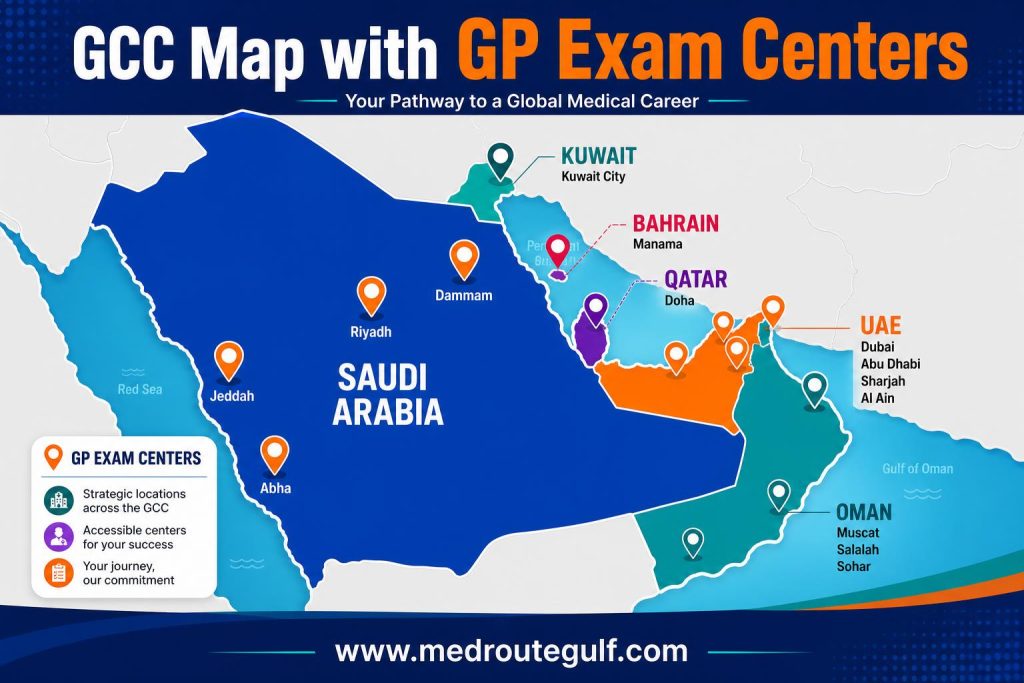
Understanding GP Prometric & Pearson VUE Exams in the GCC
What Are GP Prometric and Pearson VUE Exams?
Prometric is a global leader in computer-based testing and assessment, serving as the official testing provider for most Gulf medical licensing exams. When General Practitioners refer to taking the “Prometric exam” in the Gulf, they are typically referring to licensing examinations administered on behalf of authorities such as the Saudi Commission for Health Specialties (SCFHS), Dubai Health Authority (DHA), UAE Ministry of Health (MOH), Qatar Council for Healthcare Practitioners (QCHP), Oman Medical Specialty Board (OMSB), Bahrain’s NHRA, and Kuwait’s Ministry of Health.
Pearson VUE, another global computer-based testing giant, serves as the primary delivery partner for specific Gulf licensing exams—most notably the Abu Dhabi Department of Health (DOH) GP exam, formerly known as HAAD. Pearson VUE also administers numerous professional certification exams across the GCC.
GP Prometric exam preparation GCC requires understanding that each authority has its own exam—a DHA GP exam result cannot be used for DOH, SCFHS, or any other authority. The exams are authority-specific and profession-specific, though the testing format (MCQ, computer-based) remains consistent.
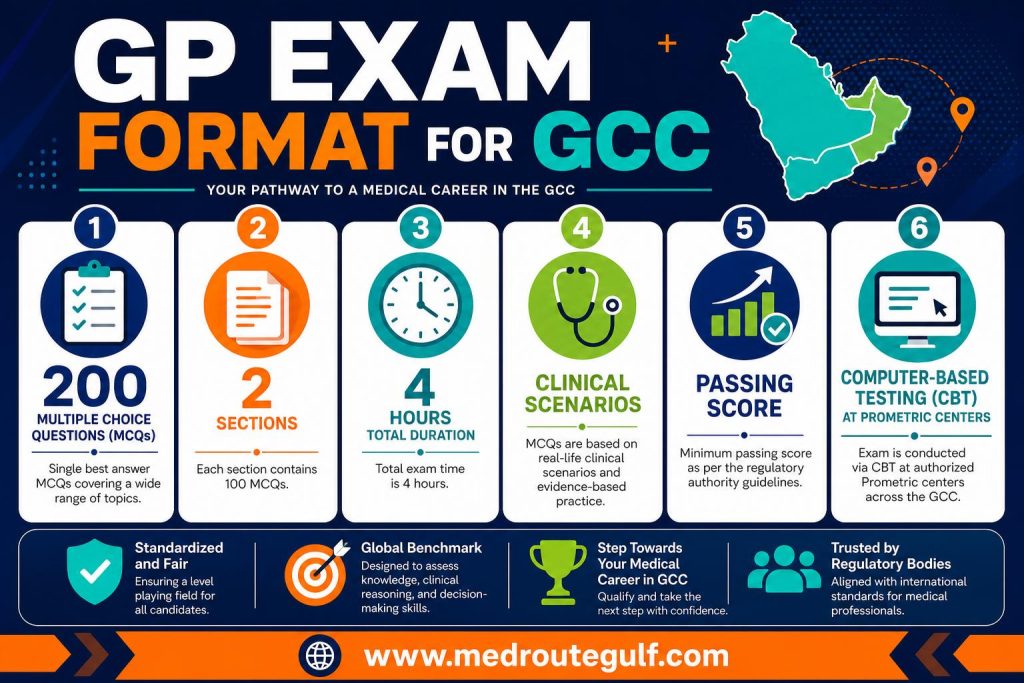
Key Differences Between GP Prometric and Pearson VUE in the GCC
| Feature | Prometric | Pearson VUE |
|---|---|---|
| Primary GCC Use | Most GP licensing exams (DHA, SCFHS, MOH UAE, QCHP, OMSB, NHRA, Kuwait MOH) | DOH Abu Dhabi GP exam |
| Question Format | Clinical vignette-based MCQs | Clinical vignette-based MCQs |
| Question Count | 150 MCQs for GP | 100-150 MCQs for GP |
| Test Centers | Extensive network across all GCC countries | Centers in Dubai, Abu Dhabi, Riyadh, Doha, Manama, Kuwait City, Muscat |
| Remote Testing | Limited | OnVUE remote proctoring available |
| Booking Platform | Authority-specific portals | TAMM portal (for DOH) |
GP Exam Format Overview
Both GP Prometric and Pearson VUE exams share a common computer-based testing format:
- Question Type: Single-best-answer multiple-choice questions (MCQs) based on clinical scenarios
- Question Count: Typically 150 MCQs for GP candidates
- Time Allowed: Approximately 3 hours
- Delivery: Computer-based at official test centers
- Subjects Covered: Internal Medicine (35–40%), Surgery (20–25%), Pediatrics (20–25%), and Obstetrics & Gynaecology (15–20%)
- Passing Score: Typically 60–65%
Why GP Prometric Exam Preparation Matters in 2026
The GCC healthcare landscape is evolving rapidly. Licensing authorities are placing greater emphasis on clinical judgment over rote memorization. General Practitioners who succeed are those who can quickly identify clinical priorities, recognize red flags, and choose the safest, most appropriate next step in patient care.
In 2026, the biggest mistake GP candidates make is preparing randomly. Reading textbooks cover to cover without targeted practice rarely translates to exam success. Gulf GP exams reward candidates who understand MCQ patterns, can manage time pressure, and have developed the clinical reasoning skills that mirror real-world practice. GP Prometric exam preparation GCC must be systematic, focused, and aligned with the specific authority’s blueprint.
GCC Country-by-Country GP Exam Guide
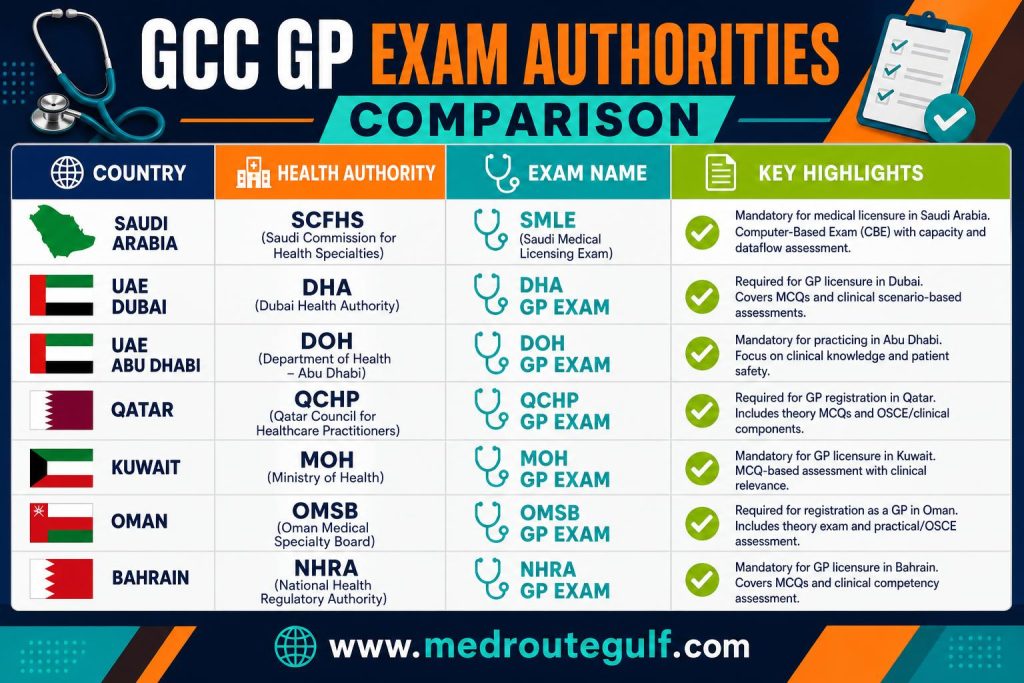
Saudi Arabia – SCFHS / Saudi Prometric (SMLE)
The Saudi Commission for Health Specialties (SCFHS) administers licensing exams through Prometric for all General Practitioners seeking to practice in the Kingdom.
- Exam Name: SMLE (Saudi Medical Licensing Exam) for GPs and specialists
- Platform: Prometric
- Question Count: Approximately 100-200 MCQs
- Duration: 3-4 hours, varying by specialty
- Passing Score: 560 points on a scale of 200-800, approximately 62.5%
- Preparation Time: 12-16 weeks typical
- Key Requirement: DataFlow verification + Mumaris+ registration
- Exam Fee: SAR 1,200-1,400
Official SCFHS website: Click Here
Read Our
Compete Guide for GP Saudi Exam Here
United Arab Emirates
The UAE has three separate health regulatory authorities, each with its own GP licensing exam pathway:
Dubai – DHA GP Exam
- Authority: Dubai Health Authority
- Platform: Prometric
- Question Count: 150 MCQs for GP
- Duration: Approximately 170 minutes
- Passing Score: ~60-65%
- Preparation Time: 10-12 weeks typical
- Requirements: Graduation from a recognized medical school listed on Avicenna database; international candidates need at least 2 years clinical experience after housejob/internship
Abu Dhabi – DOH GP Exam (formerly HAAD)
- Authority: Department of Health Abu Dhabi
- Platform: Pearson VUE (unique among UAE exams)
- Question Count: 100-150 MCQs focused on clinical scenarios
- Duration: Approximately 3 hours
- Passing Score: 60% or above for GP doctors
- Preparation Time: 10-12 weeks typical
- Booking: Through the TAMM portal
Northern Emirates – MOH UAE GP Exam
- Authority: UAE Ministry of Health and Prevention (MOHAP)
- Platform: Prometric
- Question Count: Approximately 150 MCQs
- Duration: Approximately 3 hours
- Difficulty: Generally considered the most accessible UAE entry point for international GP graduates
- Requirements: Graduated from a recognized medical school; at least 2 years clinical experience after housejob
Qatar – QCHP GP Exam
- Authority: Qatar Council for Healthcare Practitioners
- Platform: Prometric
- Question Count: 150 MCQs
- Duration: Approximately 3 hours
- Passing Score: 60%
- Subject Distribution: Internal Medicine 35–40%, Surgery 20–25%, Pediatrics 20–25%, Obstetrics & Gynaecology 15–20%
- Requirements: One year of experience to obtain a license as a General Practitioner
Oman – OMSB GP Exam
- Authority: Oman Medical Specialty Board
- Platform: Prometric
- Exam Name: Omani Examination for General Practitioners (OEGP)
- Question Count: 150 MCQs
- Duration: 2 hours 45 minutes
- Passing Score: 60%
- Requirements: MBBS or equivalent degree with completed approved internship
Bahrain – NHRA GP Exam
- Authority: National Health Regulatory Authority
- Platform: Prometric
- Subject Distribution: Internal Medicine 35–40%, Surgery 20–25%, Pediatrics 20–25%, Obstetrics & Gynaecology 15–20%
Kuwait – Kuwait MOH GP Exam
- Authority: Kuwait Ministry of Health
- Platform: Prometric
- Format: Role-dependent
Official MOH Website: Click Here
The GP Licensing Process: Step by Step
Understanding the complete licensing pathway is essential for effective GP Prometric exam preparation GCC candidates. The process typically follows three key steps:
Step 1: DataFlow / Primary Source Verification (PSV)
Before you can sit for any GCC GP licensing exam, your credentials must be verified through Primary Source Verification. DataFlow is the most commonly used verification service across the Gulf.
What You Need:
- Passport copy
- MBBS degree certificate
- Registration/license from your home country
- Internship completion certificate
- Work history documentation
- Certificate of Good Standing
Timeline: PSV typically takes 4-8 weeks, depending on the complexity of your documents and the responsiveness of verifying institutions.
Critical Advice: Do not wait for PSV to complete before starting your GP Prometric exam preparation. Many GP candidates make the mistake of delaying study until verification finishes, only to find themselves scrambling for an exam slot and losing valuable preparation time. Start GP Prometric exam preparation GCC in parallel with your PSV submission.
Get Our Complete
Dataflow Step Wise Guide
Step 2: Exam Scheduling
Once your PSV is complete or sufficiently progressed, you can schedule your GP licensing exam.
For GP Prometric Exams:
- Schedule through the relevant licensing authority’s portal (e.g., SCFHS, DHA Sheryan, MOHAP, QCHP)
- Available at test centers across all GCC countries
For Pearson VUE GP Exams (DOH Abu Dhabi):
- Schedule through the TAMM portal
- Available at Pearson VUE centers in Dubai, Abu Dhabi, Riyadh, Doha, Manama, Kuwait City, and Muscat
Important: GP exam slots fill quickly, especially during peak seasons. Book as soon as you become eligible.
Step 3: Exam Completion and GP Licensing
After passing your GP exam, you must complete your registration with the health authority by submitting your DataFlow report and exam results to obtain your official license to practice as a General Practitioner in your chosen GCC country.
Proven GP Exam Preparation Strategies
Start Early – 3 Months Minimum
The foundation of successful GP Prometric exam preparation GCC is giving yourself adequate time. Start at least 3 months before your exam date. Consistency beats cramming every time.
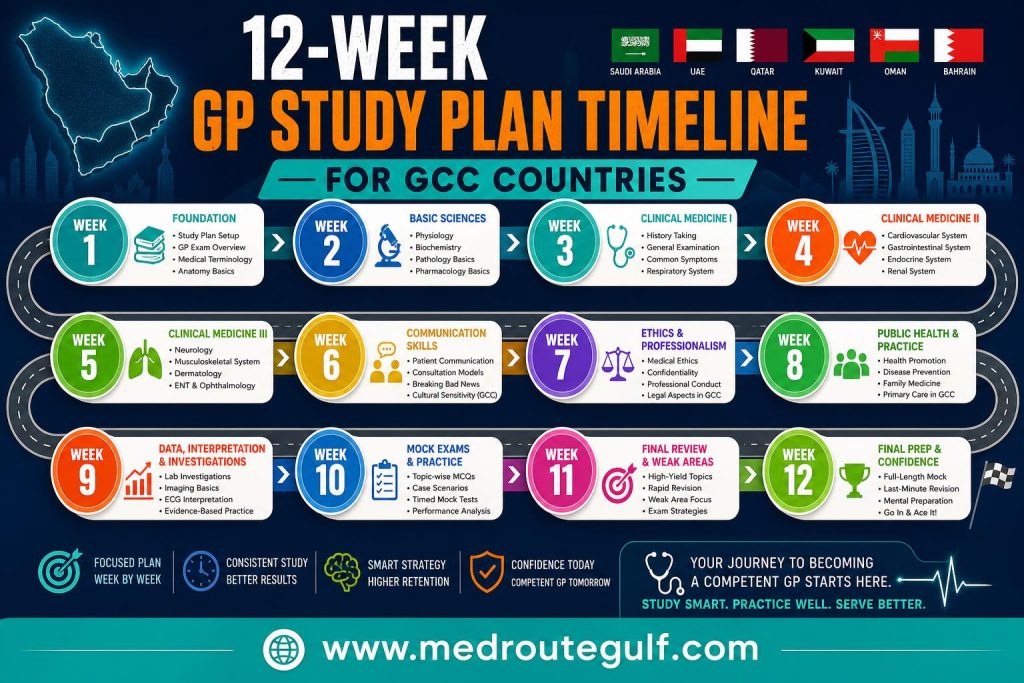
The 12-Week GP Study Roadmap
A structured 12-week plan is recommended for most Gulf GP licensing exams:
Weeks 1-2: Foundation Building
- Begin with Internal Medicine – its reasoning patterns (fluid status, sepsis recognition, AKI work-up, electrolyte correction) reappear in Surgery and OBGYN vignettes
- Build your error log now – document every mistake with the topic, why you missed it, and the correct reasoning
- Aim for 30-50 MCQs per day
Weeks 3-4: Systems-Based Review
- Move through cardiology, respiratory, endocrine, and renal systems
- Layer in Pediatrics essentials (immunization schedules, dehydration assessment, neonatal red flags)
- Pair every topic with same-day MCQ practice
Weeks 5-8: Specialty-Focused Practice
- Drill your weak subjects systematically
- Focus on Internal Medicine (highest question weight at 35-40%), Surgery (20-25%), Pediatrics (20-25%), and Obstetrics & Gynaecology (15-20%)
- For GP candidates: prioritize high-yield topics that appear most frequently
Weeks 9-10: Intensive Practice
- Use your error log data to target specific weak areas
- Increase daily MCQ volume
- Begin incorporating timed practice sessions
Weeks 11-12: Mock Test Phase
- Shift entirely to timed mock tests to simulate real exam pressure
- Schedule at least 1 full-length mock before your exam date
- Focus on time management and building stamina
Quality Over Quantity
Aiming for 30-50 MCQs per day with quality revision matters more than raw quantity. Every wrong answer is a learning opportunity. Read the explanation for each MCQ to understand the underlying clinical reasoning, not just memorize answers.
Master the MCQ Format
GP Prometric and Pearson VUE questions often hinge on one key word. Always read the question stem carefully.
The SAFE Approach for GP Candidates:
- S – Stabilize the patient first
- A – Assess airway, breathing, circulation, and vitals
- F – Find red flags, contraindications, and safety risks
- E – Eliminate unsafe, extreme, or delayed options
Use Updated, Country-Specific GP Materials
Each authority has its own licensing portal, eligibility rules, and professional qualification requirements. Your GP Prometric exam preparation GCC must match your specific authority and profession.
Available Resources for GP Candidates:
- Commercial question banks specific to DHA/DOH/Prometric GP exams
- Online courses and platforms
- Study groups and online communities
- Profession-specific MCQ books
- Full-length mock tests in Prometric format
Whats New?? Let’s Find Out
- QCHP Qatar GP Licensing: Dataflow to QCHP Exams For GP Complete Process
- GCC Anesthesia License Requirements: The Ultimate 2026 Guide for Every Gulf Country
- MOH UAE vs DHA: Which GP Exam Should You Choose in 2026?
- SMLE DHA Comparison 2026: Don’t Make This Costly Career Mistake
- OMSB Exam Preparation: Your Complete Roadmap to Oman GP Success
Common Mistakes GP Candidates Must Avoid
1. Memorization Over Understanding
The strongest GP candidates in 2026 are not the ones who memorize the biggest book. They are the candidates who can quickly identify the clinical priority. Focus on developing clinical reasoning, not rote learning.
2. Uneven Study Distribution
If 60% of your errors were in specific subjects, those subjects should receive 60% of your study time – not an equal split across all topics.
3. Neglecting Mock Tests
Mock exams are essential for GP candidates. Most GPs prepare for 10 to 12 weeks with daily study and mock test practice. Don’t skip this critical phase.
4. Starting PSV Too Late
The fastest way to lose weeks is to wait for PSV to fully finish before starting prep. Start your GP Prometric exam preparation GCC in parallel with your verification process.
5. Booking the GP Exam Too Early or Too Late
Booking too early before you’re prepared creates unnecessary pressure. Booking too late risks limited slot availability. Find the balance by assessing your readiness realistically.
6. Ignoring Country-Specific GP Requirements
Each GCC country has unique requirements for General Practitioners. DHA covers Dubai only; DOH covers Abu Dhabi and Al Ain. Ensure you’re preparing for the correct GP exam for your target country and employer.
What to Expect on GP Exam Day
Before the GP Exam
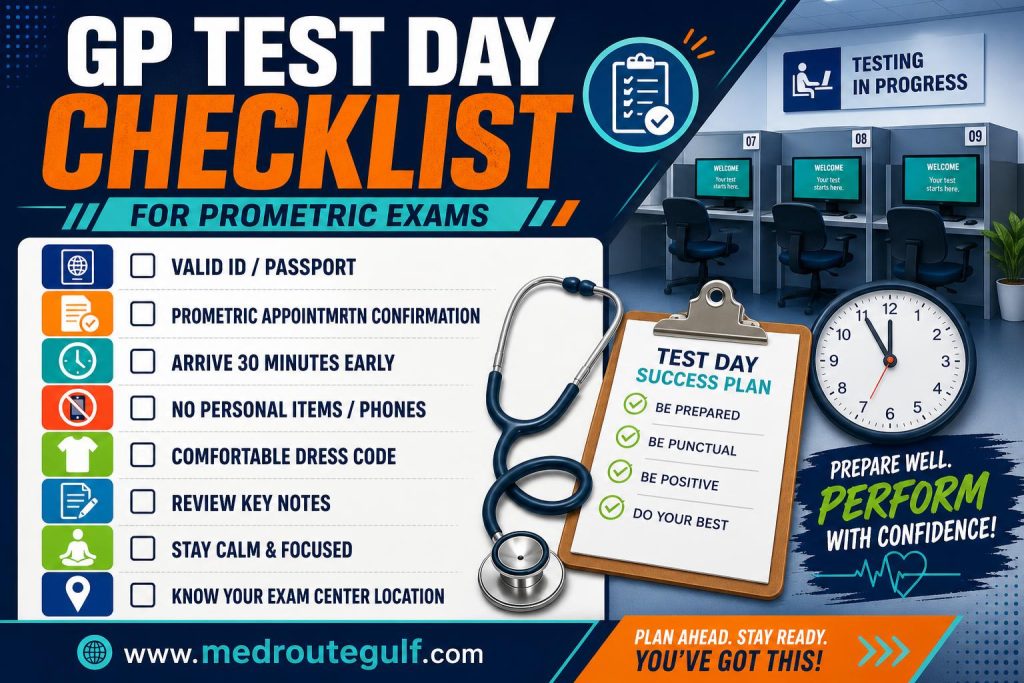
- Arrive at the test center at least 30 minutes early
- Bring valid identification (passport) and your exam confirmation
- Know your candidate number
- Familiarize yourself with the test center location in advance
During the GP Exam
- Computer-based testing with clinical vignette-based MCQs
- 3 hours of testing time for most GP exams
- No access to external materials
- Breaks may be available depending on the exam
After the GP Exam
- Results are typically processed by Prometric/Pearson VUE and then forwarded to the licensing authority
- Result timelines vary by authority
- If you pass, complete your registration with the health authority
- If you don’t pass, most authorities allow retakes after 30-90 days
Official Prometric Website: Click Here
Your Path to GP Success with MedRouteGulf
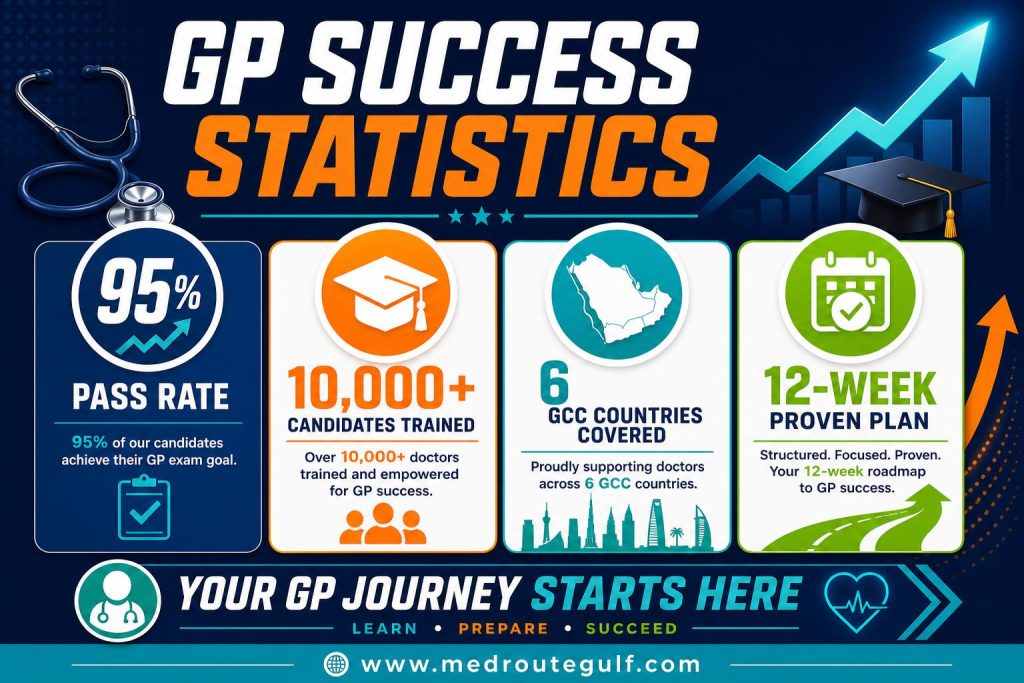
Navigating the complexities of GP Prometric exam preparation GCC can be overwhelming. From understanding which GP exam you need and completing DataFlow verification to mastering thousands of MCQs and managing exam-day anxiety, the journey requires expertise, dedication, and the right guidance.
At MedRouteGulf (www.medroutegulf.com), we understand the challenges General Practitioners face when pursuing their Gulf careers. We are dedicated to simplifying your GP licensing journey with comprehensive exam preparation services tailored to your profession and target country.
Our GP Exam Preparation Services Include:
✅ Personalized GP Study Plans – Customized to your profession, specialty, and available preparation time, ensuring you focus on what matters most for your GP Prometric exam.
✅ Comprehensive GP MCQ Banks – Access to thousands of GP Prometric and Pearson VUE-style practice questions with detailed explanations, mirroring the exact format you’ll encounter on exam day.
✅ Full-Length GP Mock Tests – Simulate real GP exam conditions with timed practice tests that build your confidence and time management skills.
✅ Expert GP Coaching – Guidance from professionals who have successfully navigated Gulf GP licensing exams and understand the nuances of each authority’s requirements.
✅ Documentation Assistance – Support with DataFlow verification, document preparation, and GP exam scheduling to streamline your entire licensing process.
✅ Country-Specific GP Guidance – Whether you’re targeting Saudi Arabia, UAE (DHA, DOH, or MOH), Qatar, Oman, Bahrain, or Kuwait, we provide targeted GP Prometric exam preparation GCC aligned with your specific authority’s blueprint.
✅ Flexible Learning Options – Self-paced study materials, live coaching sessions, and group discussion forums to suit your learning style.
Don’t let exam anxiety or inadequate GP Prometric exam preparation delay your Gulf career dreams. With MedRouteGulf, you gain a trusted partner committed to your success. Thousands of General Practitioners have already taken the step toward their Gulf careers with our support – and you can too.
Visit www.medroutegulf.com today to discover how we can help you pass your GP Prometric or Pearson VUE exam on the first attempt and begin your rewarding career as a General Practitioner in the Gulf region.
Final Thoughts
GP Prometric exam preparation GCC is a journey that requires dedication, strategy, and the right resources. The Gulf region offers tremendous opportunities for General Practitioners – competitive salaries, world-class facilities, tax-free income, and a high quality of life. But these opportunities come with a gatekeeper: the GP licensing exam.
By understanding the GP exam landscape, following a structured preparation plan, avoiding common pitfalls, and partnering with experts like MedRouteGulf, you can approach your GP exam with confidence and maximize your chances of success on the first attempt.
Remember: every successful General Practitioner in the GCC today once sat where you are now. With the right GP Prometric exam preparation GCC and mindset, you too can join their ranks and build the Gulf career you’ve been dreaming of.
Start your GP journey today. Visit www.medroutegulf.com and take the first step toward your Gulf healthcare career.
This guide is updated for 2026. GP exam formats, passing scores, and requirements are subject to change. Always confirm current requirements with the relevant licensing authority before your exam date.
Frequently Asked Questions (FAQ)
Prometric is the testing provider for most Gulf GP licensing exams, including DHA, SCFHS, MOH UAE, QCHP, OMSB, NHRA, and Kuwait MOH. Pearson VUE is primarily used for the Abu Dhabi DOH GP exam (formerly HAAD).1. What is the difference between GP Prometric and Pearson VUE exams in the GCC?
Most GP Prometric exams contain 150 MCQs. Some authorities may have 100-150 questions depending on the specific GP exam.2. How many questions are in the GP Prometric exam?
Passing scores are authority-specific, typically ranging from 60-65%. The SMLE requires approximately 62.5%, while DOH GP requires 60% or above.3. What score is needed to pass the GP Prometric exam?
Most GP candidates need 10-16 weeks of structured preparation. Start at least 3 months before your exam date. DHA GP exams typically require 10-12 weeks, while Saudi SMLE may need 12-16 weeks.4. How long should I prepare for the GP Prometric exam?
GP exams cover Internal Medicine (35–40%), Surgery (20–25%), Pediatrics (20–25%), and Obstetrics & Gynaecology (15–20%).5. What subjects are covered in the GP Prometric exam?
Yes. Prometric and Pearson VUE have test centers in most major cities worldwide. However, you should confirm availability with the specific licensing authority.6. Can I take the GP exam outside the GCC?
Most authorities allow retakes after 30-90 days. Immediately after each attempt, write down every question topic you can remember while your memory is fresh. Then create a targeted GP Prometric exam preparation plan focusing on your weak areas.7. What happens if I fail the GP exam?
Yes. DataFlow or Primary Source Verification is required for all General Practitioners seeking licenses in GCC countries. This step verifies your credentials before you can sit for the GP licensing exam.8. Is DataFlow verification required for all GCC GP licensing exams?
Difficulty depends on preparation. The MOH UAE GP exam is generally considered the most accessible UAE entry point for international GP graduates. QCHP in Qatar requires one year of experience.9. Which GCC GP exam is the easiest?
No. You only need to take the GP exam required by your target country and licensing authority. Most GP candidates take either a Prometric-administered GP exam or the Pearson VUE-administered DOH GP exam – never both.10. Do I need to take both GP Prometric and Pearson VUE exams?
To apply as a General Practitioner for the DHA GP exam, you must have graduated from a recognized medical school listed on the Avicenna database. International candidates need at least 2 years clinical experience after housejob/internship.11. What are the requirements for the DHA GP exam?
DOH GP candidates need an MBBS degree, clinical experience, and must pass a computer-based test of 100-150 MCQs focused on clinical scenarios. GP doctors need a passing score of 60% or above.12. What are the requirements for the DOH GP exam?
Fees vary by authority. SCFHS SMLE costs approximately SAR 1,200-1,400. QCHP Prometric costs approximately USD 244. Check your specific authority’s website for current fees.13. How much does the GP Prometric exam cost?
Yes, most authorities allow rescheduling, though fees may apply. Check with your specific licensing authority for their rescheduling policy.14. Can I reschedule my GP exam?
For Prometric GP exams, schedule through the relevant licensing authority’s portal (e.g., SCFHS, DHA Sheryan, MOHAP, QCHP). For the DOH Pearson VUE GP exam, book through the TAMM portal.15. How do I book my GP Prometric exam?
Pingback: 7 Essential OMSB Exam Preparation Tips for GP Doctors in Oman